
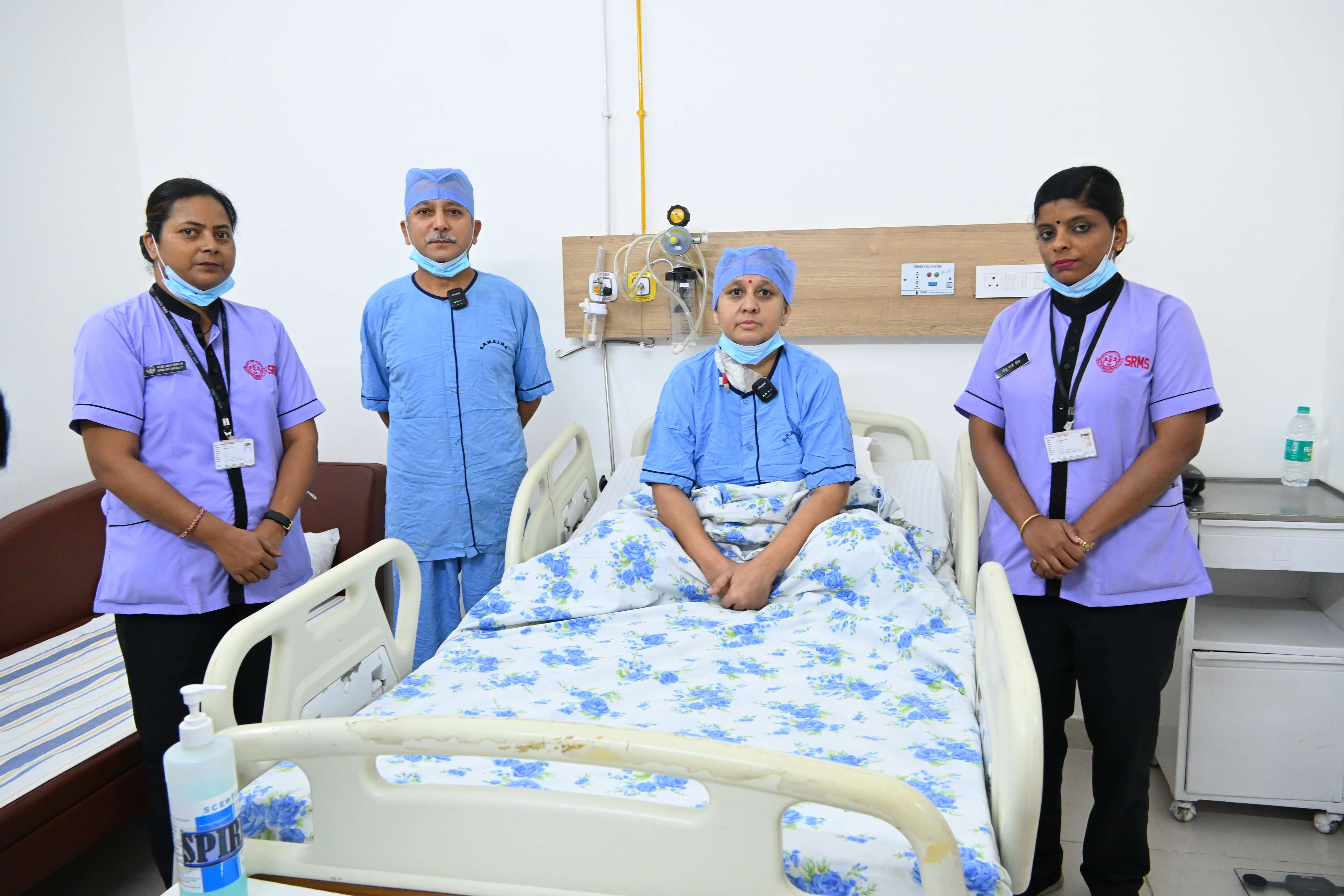
For decades, patients diagnosed with complex blood cancers across Rohilkhand and Kumaon, had only one option when advanced treatments like Bone Marrow Transplantation became necessary: travel hundreds of kilometers to metropolitan cities, often bearing immense emotional, physical, and financial burdens.
Today, that reality has changed!
In a landmark achievement that marks one of the most significant milestones in regional healthcare, SRMS Institute of Medical Sciences (IMS), Bareilly, which has been Ranked #2 Best Multi-Speciality Hospital in UP (other than NCR) by Outlook & NEB Research Survey 2026, has successfully performed the first-ever Bone Marrow Transplant (Autologous Stem Cell Transplant (ASCT)) across the entire Rohilkhand and Kumaon region, establishing a new benchmark in advanced hematological malignancy care and cellular therapy services.
With this achievement, SRMS IMS becomes the first and only centre between Delhi and Lucknow to successfully offer comprehensive Bone Marrow Transplant services, bringing world-class cancer care closer to home for thousands of patients.
FROM A CANCER DIAGNOSIS TO A STORY OF HOPE
At the heart of this historic achievement is a 47-year-old woman from Uttarakhand, whose journey reflects resilience, courage, and the power of modern medicine. For more than a year, she battled persistent back pain, weakness, abdominal discomfort, anemia, thrombocytopenia, renal dysfunction, and hypercalcaemia. What initially appeared to be routine health concerns gradually revealed a far more serious diagnosis.
Advanced investigations including Serum Immunofixation Electrophoresis, Serum Free Light Chain Assay, Fluorescence In-Situ Hybridization (FISH), Whole Body MRI, Bone Marrow Evaluation, and Immunoglobulin Studies confirmed High-Risk Multiple Myeloma (R-ISS Stage III), an aggressive blood cancer affecting plasma cells within the bone marrow. What followed was a meticulously planned treatment journey led by a highly specialized multidisciplinary team at SRMS IMS.
WHEN PRECISION ONCOLOGY MEETS ADVANCED HAEMATOLOGY
The patient underwent state-of-the-art induction and targeted therapy and the response was remarkable. Subsequent assessments demonstrated significant hematological recovery, normalization of kidney function, correction of calcium levels & Minimal Residual Disease (MRD) negativity. With the disease brought under excellent control, doctors proceeded with the next critical step, an Autologous Stem Cell Transplant (ASCT) using the patient’s own healthy stem cells to significantly reduce the risk of recurrence and consolidate long-term disease control.
COLLABORATION THAT MARKS A HISTORIC FIRST
The successful transplant was not the achievement of a single department. It was the result of seamless collaboration among multiple specialties working together with a shared vision.
This landmark achievement reflects the collective expertise, meticulous planning, and sheer dedication of the multidisciplinary medical teams at SRMS IMS. Under the overall guidance of Dr Piyush Kumar (MD, Radiotherapy), Professor & Head, Department of Radiation Oncology and Director, RR Cancer & Research Institute that has been Ranked #17 Best Oncology Hospital in India by Outlook & NEB Research Survey 2026, the complex transplant programme was executed through seamless collaboration across multiple specialties.
The Medical Oncology team, led by Dr Adadi Srinivasa Naidu (Medical Oncologist, RR Cancer Institute & Research Centre, SRMS IMS), was instrumental in treatment planning, chemotherapy administration, disease monitoring, transplant eligibility assessment, and long-term cancer management. The transplant procedure itself was spearheaded by Dr Vijay Moorthy, Visiting Consultant and Advisor, who served as the principal lead in conducting the transplant. From the Department of Clinical Hematology, Dr Disha Satya (Clinical Hematologist, SRMS IMS) played a pivotal role in disease stratification, transplant planning, and formulation of stem cell transplant protocols, response assessment, and comprehensive post-transplant hematological care. The team of Transfusion Medicine specialists, comprising Dr Milan Jaiswal (MD, Pathology & Professor and Head), Dr Ujjwal Ahuja (MD, Immunohematology & Blood Transfusion), Dr Aakriti Baijal (MD, Pathology) and dedicated Apheresis Technologists, ensured successful stem cell mobilization, therapeutic apheresis, stem cell collection, specialized blood component support, platelet management, and transplant transfusion services.
Equally significant was the contribution of the Clinical Pharmacology team, including Dr Krishna Kumar Mahto, Dr Abhishek Sinha, and Dr Rohit Yadav, who coordinated the entire transplant process with precision and continuity. The success of the procedure was further strengthened by the relentless efforts of the Critical Care teams, Nursing Services, and Diagnostic Services, including Pathology, Biochemistry, Microbiology, and advanced laboratory support systems. The nursing staff played a crucial role in round-the-clock patient monitoring, infection control, medication management, supportive care, and ensuring patient comfort throughout the transplant journey.
Together, these teams transformed one of the most complex challenges in modern cancer care into a historic healthcare milestone, bringing advanced stem cell transplantation and world-class hematological cancer care closer to the people of Rohilkhand, Kumaon, and adjoining regions.
Speaking on the pivotal role of Transfusion Medicine in this landmark procedure, Dr Milan Jaiswal said, “Our Transfusion Medicine team, along with Junior Resident doctors and Apheresis Technologists, played a critical role throughout the transplant journey. From evaluating patient fitness and carrying out precision stem cell collection and processing to ensuring graft quality assurance, secure storage, graft infusion, and patient monitoring, every step was meticulously managed. Simultaneously, the department provided comprehensive peri-transplant blood component support and successfully coordinated the entire plateletpheresis process, from NGO-led community awareness and donor mobilization to donor screening, fitness assessment, and the collection of Single Donor Platelets (SDPs), ensuring uninterrupted support during the transplant period.”
EXCELLENCE THAT CARVES NEW HOPE FOR THE FUTURE
Following successful stem cell mobilization, stem cells were collected through advanced therapeutic apheresis. The patient subsequently received high-dose Melphalan conditioning chemotherapy and was shifted to a dedicated transplant isolation facility equipped with HEPA filtration systems, advanced infection-control measures and specialized transplant monitoring facilities. The Autologous Stem Cell Infusion was successfully performed, marking the beginning of a new chapter in cancer care for the region.
During the post-transplant phase, the patient remained under close multidisciplinary supervision with continuous clinical monitoring, specialized nursing support, and regular laboratory evaluations. In yet another encouraging outcome, the patient recovered exceptionally well and was shifted from the transplant unit to the ward on the 19th day, significantly ahead of the usual recovery timeline of approximately 30 days.
A COMMUNITY THAT CARES AND HEALS
During the critical post-transplant aplastic phase, the patient required Single Donor Platelet (SDP) support. Demonstrating the strength of community participation in advanced healthcare, voluntary platelet donors stepped forward to ensure uninterrupted patient care during this crucial period. Their contribution became an important reminder that life-saving therapies are strengthened not only by medical expertise but also by collective human compassion.
AFFORDABLE AND WORLD-CLASS CARE, NOW CLOSER TO HOME
Beyond its clinical significance, the achievement carries enormous implications for healthcare accessibility. At SRMS IMS, the entire transplant procedure was successfully completed at an approximate cost of ₹6–8 lakh, compared to ₹10–12 lakh and often ₹20–25 lakh at many specialized centres, making advanced cancer care significantly more affordable and accessible.
Dr Adadi Srinivasa puts, “Traditionally, Bone Marrow Transplant procedures often require patients to travel to major metropolitan centers, resulting in substantial logistical and financial challenges. Hence, for countless families across UP and Uttarakhand, this represents hope, convenience, and the possibility of receiving advanced treatment without leaving their home region.”
THE INFRASTRUCTURE BEHIND THE MILESTONE
This historic success is the culmination of years of planning, investment, training, and infrastructure development. Key facilities enabling the transplant programme include:
• Dedicated Bone Marrow Transplant Isolation Units
• Advanced Therapeutic Apheresis Services
• Comprehensive Transfusion Medicine Support
• Specialized Nursing Teams
• Round-the-Clock Critical Care Services
• Advanced Diagnostic Laboratories
• Integrated Pathology, Biochemistry & Microbiology Services
• Robust Infection Control Systems
Having established the region’s first Bone Marrow Transplant Unit in 2026, SRMS IMS is now further expanding its transplant facilities to support a greater number of successful procedures and develop a dedicated Bone Marrow Transplant Wing.
A VISION THAT’S TRANSFORMING REGIONAL HEALTHCARE
This milestone reflects the visionary leadership of Shri Dev Murti, Chairman, SRMS Trust, whose commitment to bringing advanced healthcare services to underserved regions continues to redefine the healthcare landscape of North India. His vision has always been clear: patients should not have to leave their region to access world-class medical care. The successful completion of the first Bone Marrow Transplant and Region’s First Autologous Stem Cell Transplant is a powerful realization of that vision. It is proof that world-class stem cell transplantation can be delivered with excellence, affordability, and compassion in a rural-based tertiary care institution. Most importantly, it is a promise to every patient battling blood cancer that advanced treatment, expert care, and renewed hope are now available closer to home than ever before.
This is more than a medical achievement. It is hope, healing, and history in the making!
